"The situation is serious." That warning about France's public debt, repeated in every tone by François Bayrou, has not borne fruit. While the French people have expressed growing concern over the issue, the vast majority remain unwilling to shoulder the budgetary efforts requested by a prime minister whose unpopularity has reached record levels and who has struggled to convince the public that his savings plan is fair. The gamble of calling for a vote of confidence, scheduled for Monday, September 8, at the Assemblée Nationale, has begun to backfire on its initiator. For someone who aimed to reconcile a divided nation, the failure has been stinging and has only further complicated an already challenging equation.
While there is no point in dramatizing the budget situation, it is nonetheless essential to look at the problem with clear eyes. France has been living beyond its means, and borrowing is becoming increasingly expensive. The main challenge of reducing the debt is to preserve the country's ability to maintain enough flexibility to shape its own political and economic decisions – in other words, to safeguard its sovereignty.
Continuing to let our deficits spiral out of control by funding everyday expenses without seeking to increase the wealth produced has become unsustainable. If France does not quickly put the brakes on the debt, which now exceeds €3,400 billion, our borrowing conditions will inevitably worsen, increasing the burden of interest payments and reducing our investment capacity. We would be condemning ourselves to mortgaging the country's future.
Historic shifts
Interest payments on the debt are about to become France's largest budget item. That means tens of billions of euros would need to be raised through new taxes or by taking on even more debt in a deadly, vicious circle. This fall, in the absence of a credible budget and political stability, financial rating agencies will downgrade France's sovereign debt, driving borrowing costs even higher. These costs are already higher than those of Greece or Spain, and now match those of Italy, long considered the "sick man of Europe." Under such conditions, how can France continue to defend its interests on the international stage at a time of historic shifts in the global order?
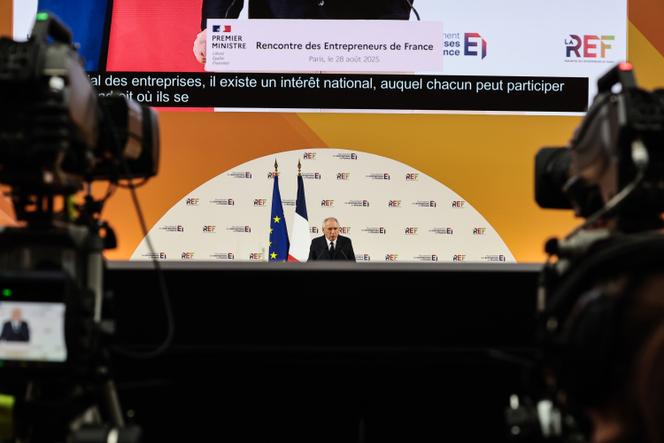
Whatever mistakes Bayrou may have made in his approach, every stakeholder – be it political parties or labor unions – must regroup and agree to enter into a spirit of compromise, even as the current temptation is to defend their own interests at all costs. Employers are escalating their demands for free-market reforms, when the real challenge is to reach an agreement on a minimum acceptable to all French people. The unions immediately rule out any sacrifices for employees, as though the demand for "always more" were still viable in this intractable situation. The left blocks any reduction in spending, while the right opposes any tax increases. Everyone shifts responsibility for the stalemate onto the others.
Although not insignificant, the budget tightening requested for 2026 does not constitute an austerity plan. It represents 2.6% of public spending, which will continue to rise. If, within this framework, each party refuses to make even minimal concessions to share the budgetary effort fairly, refusing to cooperate will only make the problem worse and increase the final cost. There will be no winners.