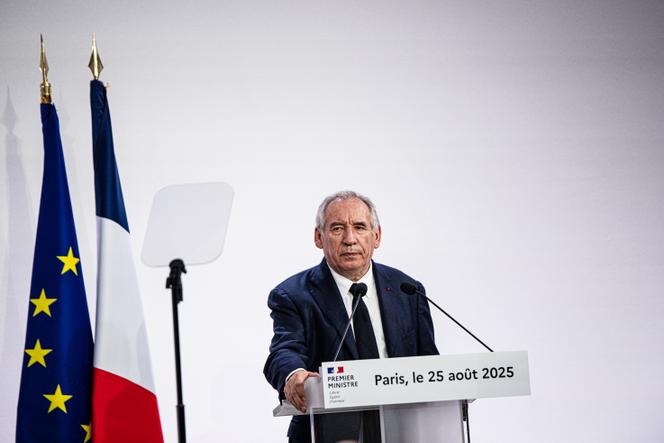
With his efforts at persuasion having failed, French Prime Minister François Bayrou decided to go all in to convince the French public of the need to regain control over the country's finances. On Monday, August 25, Bayrou announced that he would seek a vote of confidence on September 8 in the Assemblée Nationale, the lower house of the French parliament. This vote would tie the government's future to a policy statement aimed at securing a majority agreement on two points: that France's debt has become excessive and the urgent need to address it "by spending less and producing more." Without this crucial clarification, Bayrou argued it would be impossible to carry out his plan and he would have no choice but to step down.
Confronted with a debate that, in his own words, "has descended into confusion" and been "derailed" by opposition parties accused of remaining in denial without taking into account the scale of the challenge, the prime minister tried to regain control by forcing everyone to face up to their responsibilities. He is proceeding on the assumption that if there is not at least a basic consensus on the seriousness of the situation and the need to urgently address it, France will be unable to resolve its financial deadlock.
The July 15 announcement of an almost €44 billion cut in the 2026 budget to reduce the deficit already sparked widespread backlash. This "moment of truth," intended to rally public opinion and create a shock, produced exactly the opposite effect. Measures that were particularly unpopular – such as the elimination of two public holidays and a freeze on pensions, minimum welfare benefits and tax brackets – have divided the country. Unable to convince the public that the sacrifices would be shared fairly, the prime minister faced a wave of resentment. The radical left-wing La France Insoumise (LFI) party's threat to file a motion of no confidence as soon as Parliament resumed on September 23 was soon joined by the far-right Rassemblement National (RN). Most notably, however, was the emergence of a nebulous protest movement promising to bring the country to a standstill on September 10, cheered on by much of the left.
A critical moment
With his approval rating at a record low, Bayrou saw his room for maneuver shrinking. He could either allow the budget debate, already off to an awful start, to run its course, with a high likelihood of a no-confidence vote. Or he could risk everything by separating the need for an austerity plan from the details of its implementation, in the hope of clarifying the situation.
This high-stakes gamble, which allows him to remain true to his long-held message of fiscal seriousness, resembles the one taken by Emmanuel Macron when he dissolved the Assemblée Nationale just over a year ago. Equally risky, it seems just as poorly positioned from the outset. The RN, LFI, the Socialists and the Communists have already announced they will not support the government. The prime minister still wants to believe that "there are times when a calculated risk can help avoid the worst." Yet the worst seems to be looming. If the government were to fall at this critical juncture – just two days before a wave of social unrest reminiscent of the Yellow Vest movement, with no credible budget plan in sight and under increasing pressure from financial markets – Bayrou's warnings would have been for nothing. The departure of the messenger would only complicate the very thing he was trying to resolve: France's financial equation.