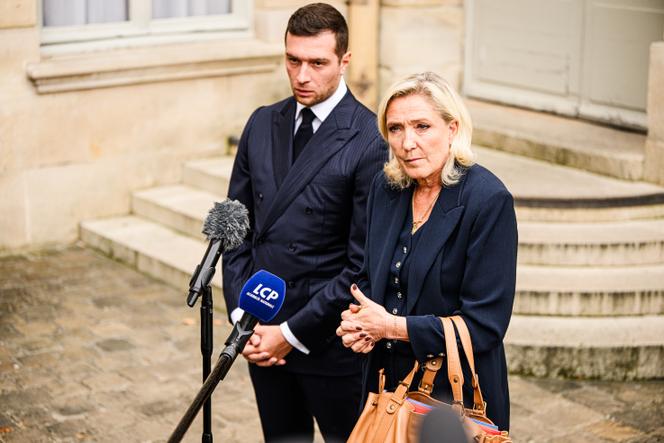
Last-ditch talks between the French far right and Prime Minister François Bayrou did not achieve any breakthrough, its leaders said Tuesday, September 2, heightening the chances the centrist head of government will lose a confidence vote next week. Three-time presidential candidate Marine Le Pen and her right-hand man and Rassemblement National party leader Jordan Bardella urged swift snap legislative elections after the vote in parliament on Monday to end a months-long standoff over the budget.
"Jordan and I are calling for an extremely rapid dissolution" of the Assemblée Nationale, Le Pen said alongside Bardella after one hour of talks with Bayrou at his offices in Paris. "The sooner we return to the polls, the sooner France will have a budget," Bardella said, adding "no miracle" had come out of the meeting to change the party's mind.
Analysts expect Bayrou and his government to fall on Monday after just over half a year in office, with both the far right and left-wing parties vowing to vote against his minority administration. President Emmanuel Macron will then need to decide whether to reappoint Bayrou, choose a new premier who would be the seventh government chief of his presidency or call snap legislative elections. Macron himself could also resign, as called for by the hard left, but he has repeatedly ruled out this course of action.
Six days ahead of the vote, Macron summoned the chiefs of the minority group of centrist and right-wing parties who back Bayrou and the president for a meeting at the Elysée.
All the party leaders present at the meeting, which included former prime minister Gabriel Attal, who currently leads Macron's own centrist party, expressed their opposition to calling snap elections should the government fall on Monday.
Former president Nicolas Sarkozy, who is known to retain informal contact with Macron despite a graft conviction, said there was "no other solution" to France's political crisis other than snap elections. Speaking to Le Figaro, he described Bayrou's decision to call the confidence vote next Monday as "political suicide."
January 9, 2024: After a tense vote in the Assemblée Nationale, Emmanuel Macron decided to reshuffle his cabinet and name a new prime minister, Gabriel Attal.
June 9, 2024: Marine Le Pen's far-right Rassemblement National (RN) obtained a historic score in the European Parliament elections, winning 30 of France's 81 seats. One hour after the results were announced, Macron shocked the nation by dissolving the Assemblée Nationale, triggering snap elections.
July 7, 2024: The left-wing Nouveau Front Populaire (NFP) alliance defied expectations of an RN victory and won more seats than any other bloc. The NFP later put forward Lucie Castets, a little-known civil servant, as its candidate for prime minister.
September 5, 2024: Macron picked Michel Barnier, of the conservative Les Républicains (LR) party, to become prime minister. Together, Macron's coalition and LR had more seats than the NFP.
December 4, 2024: Barnier's government collapsed as the far right and left backed a motion of confidence. The votes also scuttled Barnier's budget for 2025.
December 13, 2024: Macron appointed his longtime centrist ally François Bayrou to replace Barnier. The coalition backing Bayrou in Parliament was the same as Barnier's.
February 6, 2025: France belatedly passed a budget for 2025 as Bayrou forced the legislation through without a vote. The RN and the Socialists abstained from backing the resulting motion of no confidence.
August 25, 2025: Bayrou called a vote of confidence ahead of the 2026 budget debates.
September 8, 2025: Bayrou ousted as prime minister after losing confidence vote at the Assemblée Nationale.
September 10, 2025: A day of protest under the slogan "Block Everything" is scheduled.